

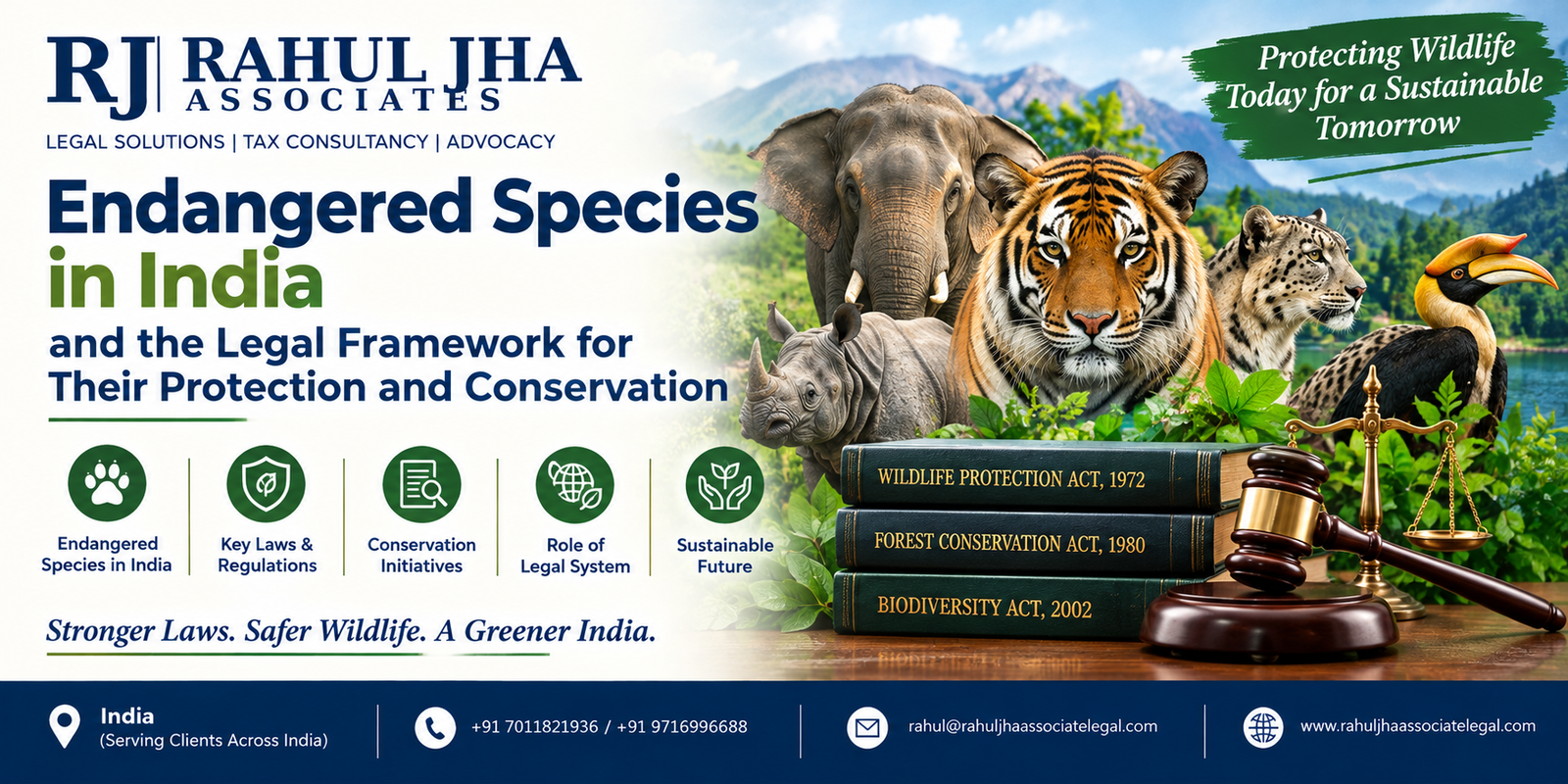
Endangered Species in India and the Legal Framework for Their Protection and Conservation
Introduction
India is one of the world’s most biologically diverse countries, home to a remarkable variety of wildlife, forests, wetlands, grasslands, and marine ecosystems. From the Royal Bengal Tiger and Asiatic Lion to the Great Indian Bustard, Gangetic River Dolphin, and Red Panda, India’s wildlife represents an invaluable natural heritage. However, habitat destruction, poaching, illegal wildlife trade, pollution, climate change, and human–wildlife conflict have placed numerous species under serious threat.
The protection of endangered species is not merely an environmental concern; it is also a matter of legal responsibility, ecological sustainability, and intergenerational justice. Recognizing the importance of wildlife conservation, India has developed a comprehensive legal framework through constitutional provisions, parliamentary legislation, judicial decisions, and international agreements. Nevertheless, the effectiveness of these laws depends on their proper implementation, public awareness, and cooperation between government authorities and local communities.
Endangered Species in India: Major Threats
An endangered species is one facing a significant risk of extinction in the wild. Conservation status is assessed by organizations such as the International Union for Conservation of Nature (IUCN), which classifies species into categories including Vulnerable, Endangered, and Critically Endangered.
Some important examples of threatened wildlife in India include the following:
- Bengal Tiger: Despite conservation initiatives, tigers continue to face habitat fragmentation, poaching, and conflicts with human settlements.
- Asiatic Lion: Concentrated primarily in Gujarat’s Gir landscape, the species faces risks associated with disease, limited geographical distribution, and human–wildlife conflict.
- Great Indian Bustard: This critically endangered bird is threatened by habitat loss, changes in grassland use, and collisions with overhead power lines.
- Ganges River Dolphin: River pollution, dams, fishing activities, and habitat degradation threaten this freshwater mammal.
- Red Panda: Found in parts of the eastern Himalayas, it faces deforestation, habitat fragmentation, and other pressures on its forest habitat.
- Gharial: This critically endangered reptile faces threats from river modification, sand mining, fishing practices, and the degradation of nesting sites.
These examples demonstrate that wildlife conservation requires more than protecting individual animals. It also requires preserving the ecosystems in which they live and ensuring that human development does not irreversibly damage their habitats.
Constitutional Provisions for Wildlife Protection
The Constitution of India provides a strong foundation for environmental protection and wildlife conservation.
Article 48A—Directive Principle of State Policy: It directs the State to protect and improve the environment and safeguard forests and wildlife. Although it is not independently enforceable in the same manner as a fundamental right, it guides environmental legislation and government policy.
Article 51A(g)—Fundamental Duties: It imposes a duty on every citizen to protect and improve the natural environment, including forests, lakes, rivers, and wildlife, and to show compassion for living creatures.
Article 21 — Right to Life: The Supreme Court has interpreted the right to life broadly to include dimensions of environmental protection and the right to live in a healthy environment. This constitutional interpretation strengthens the legal basis for addressing environmental degradation that threatens human well-being.
Article 246 and the Seventh Schedule: These provisions allocate legislative powers between Parliament and State Legislatures. Forests and the protection of wild animals and birds are included in the Concurrent List, enabling both levels of government to legislate in these areas, subject to constitutional rules.
Together, these provisions establish that wildlife conservation is a shared constitutional responsibility of the State, citizens and public institutions.
Major Indian Laws for the Protection of Endangered Species
1. The Wild Life (Protection) Act, 1972
The Wildlife (Protection) Act, 1972, is the principal legislation governing wildlife conservation in India. Its primary objective is to protect wild animals, birds, and plants and ensure the ecological security of the country. The Act was significantly amended in 2022, with the amendments coming into force on 1 April 2023.
Its major provisions include:
- Protection of specified species: The Act provides varying levels of legal protection through its schedules. Schedule I provides stringent protection to specified animal species, while Schedule II covers other protected animal species.
- Prohibition of hunting: Section 9 generally prohibits the hunting of protected wild animals, subject to limited statutory exceptions.
- Protected areas: The Act provides for the establishment and management of national parks, wildlife sanctuaries, conservation reserves, and community reserves.
- Regulation of wildlife trade: It regulates the possession, transfer, and trade of protected wildlife and their derivatives.
- Penalties for offenses: Section 51 prescribes penalties for contraventions of the Act, with enhanced consequences for certain serious offenses.
The 2022 amendment also introduced provisions to strengthen India’s implementation of the Convention on International Trade in Endangered Species of Wild Fauna and Flora (CITES). This is particularly significant in combating illegal international trade in endangered animals and plants.
2. The Environment (Protection) Act, 1986
The Environment (Protection) Act, 1986 was enacted to provide a comprehensive framework for environmental protection and improvement. Although it is not exclusively concerned with endangered species, it plays an important supporting role in wildlife conservation.
The Act empowers the Central Government to take measures to protect and improve environmental quality, regulate activities that may cause pollution, and prescribe safeguards for environmentally sensitive areas. These powers can help address threats such as industrial pollution, hazardous waste, habitat degradation, and other activities that damage wildlife ecosystems.
For instance, the protection of wetlands, forests, and river systems can contribute directly to the survival of species such as the Gangetic River Dolphin and numerous threatened birds.
3. The Biological Diversity Act, 2002
The Biological Diversity Act, 2002, as amended in 2023, seeks to conserve biological diversity, promote its sustainable use, and ensure fair and equitable sharing of benefits arising from the use of biological resources.
The legislation establishes a framework involving the National Biodiversity Authority, State Biodiversity Boards, and local Biodiversity Management Committees. These institutions contribute to biodiversity conservation, documentation of biological resources and associated traditional knowledge, and the regulation of relevant activities.
Section 38 empowers the Central Government to notify threatened species on the recommendation of the relevant State Government and take measures for their rehabilitation and preservation.
This provision is particularly relevant because endangered species cannot be protected effectively without addressing the wider loss of biodiversity and the degradation of their habitats.
4. The Forest (Conservation) Framework
The Van (Sanrakshan Evam Samvardhan) Adhiniyam, 1980, formerly known as the Forest (Conservation) Act, 1980, regulates the diversion of forest land for non-forest purposes within its statutory scope.
Forest conservation is closely connected with wildlife protection because forests provide food, shelter, breeding grounds, and migration corridors for numerous species. Unplanned diversion and fragmentation of forest habitats can isolate wildlife populations and increase the likelihood of human–animal conflict.
The legal framework governing forests must therefore be implemented alongside wildlife legislation to ensure that development projects adequately consider ecological consequences and applicable statutory requirements.
5. The Prevention of Cruelty to Animals Act, 1960
The Prevention of Cruelty to Animals Act, 1960 seeks to prevent the infliction of unnecessary pain or suffering on animals. Although it is not a substitute for the Wild Life (Protection) Act, it provides an additional legal framework addressing animal welfare.
Its relevance to endangered species arises in circumstances involving animal handling, captivity, and other activities within the Act’s scope. Where protected wildlife is involved, the specific requirements of wildlife legislation must also be considered.
6. The Indian Forest Act, 1927
The Indian Forest Act, 1927, provides a framework for the classification, management, and protection of certain categories of forests and forest produce. It supports forest governance and can contribute to the protection of habitats on which wildlife depends.
However, forest protection under this Act must be understood alongside the more specific wildlife and forest-conservation laws applicable to a particular area or activity.
International Legal Framework for Wildlife Conservation
Wildlife conservation is a global concern because illegal wildlife trade, habitat destruction, and biodiversity loss frequently cross national boundaries. India participates in several international agreements that complement domestic legislation.
Convention on International Trade in Endangered Species of Wild Fauna and Flora (CITES), 1973: CITES regulates international trade in listed wild animals and plants through a system of permits and trade controls. India’s amended wildlife legislation incorporates provisions to implement its obligations under the Convention.
Convention on Biological Diversity (CBD), 1992: The CBD requires its parties to pursue biodiversity conservation, sustainable use and fair and equitable sharing of benefits arising from genetic resources. It provides a broader framework for protecting ecosystems and threatened species.
Convention on the Conservation of Migratory Species of Wild Animals (CMS), 1979: This Convention promotes international cooperation for the conservation of migratory species and their habitats. Such cooperation is important for species whose migration routes cross national borders.
These international instruments reinforce the principle that endangered species must be protected through coordinated domestic and international action.
Role of the Indian Judiciary in Wildlife Protection
The Indian judiciary has played an important role in interpreting environmental rights, reviewing government action and strengthening accountability for ecological damage.
In T.N. Godavarman Thirumulpad v. Union of India (1997), the Supreme Court issued significant directions concerning forest conservation and the interpretation of forest-related law. The continuing proceedings have influenced forest governance and environmental protection in India.
In Centre for Environmental Law, WWF-India v. Union of India (2013), the Supreme Court considered the conservation of the Asiatic Lion and the proposal to establish a second free-ranging population in Madhya Pradesh. The judgment highlighted the importance of species conservation, scientific assessment and reducing the risks associated with concentrating a species in a single geographical area.
In Animal Welfare Board of India v. A. Nagaraja (2014), the Supreme Court discussed animal welfare and compassion for living creatures in the context of the applicable legislation and constitutional values. Although the case was not specifically about endangered species, its reasoning is relevant to broader discussions of animal protection.
Judicial intervention is important where environmental clearances, habitat destruction, illegal hunting or failures of enforcement raise questions of statutory compliance and constitutional responsibility.
Challenges in Implementing Wildlife Protection Laws
Despite an extensive legal framework, several obstacles continue to threaten endangered species in India.
1. Poaching and illegal wildlife trade: The demand for animal skins, bones, horns and other wildlife products creates incentives for organised illegal activities.
2. Habitat destruction and fragmentation: Roads, mining, urban expansion, dams and other infrastructure can damage habitats and disrupt migration corridors.
3. Human–wildlife conflict: Encounters between people and wild animals can result in injury, loss of life, crop damage and retaliatory harm to wildlife. Conservation policies must address the concerns of affected communities.
4. Weak enforcement and resource constraints: Inadequate staffing, limited monitoring facilities, insufficient training and difficulties in investigating wildlife offences may undermine the effectiveness of the law.
5. Climate change and pollution: Changing temperatures, extreme weather, contaminated rivers and degraded ecosystems can threaten the food sources and breeding conditions of vulnerable species.
6. Limited public awareness: Illegal wildlife products and harmful practices may persist where people do not understand the ecological consequences or the applicable legal prohibitions.
These challenges demonstrate that the existence of legislation alone cannot guarantee the survival of endangered species. Effective enforcement, scientific planning and community participation are equally necessary.
Recommendations for Strengthening Wildlife Conservation
India can strengthen its wildlife protection framework through the following measures:
- Improve law enforcement: Forest departments and wildlife enforcement agencies should receive adequate funding, training, technology and investigative support.
- Protect critical habitats: Development projects should be assessed carefully for their effects on biodiversity, wildlife corridors and ecologically sensitive areas.
- Strengthen prosecution: Wildlife offences should be investigated and prosecuted effectively, with due process and timely adjudication.
- Promote community participation: Local communities, particularly those living near protected areas, should participate in conservation planning and receive fair, timely support where wildlife causes damage.
- Expand scientific research: Population monitoring, habitat mapping, genetic research and disease surveillance can help conservation authorities make evidence-based decisions.
- Regulate illegal trade: Cooperation between enforcement agencies, customs authorities and international partners should be strengthened to identify and disrupt wildlife trafficking networks.
- Increase public awareness: Educational institutions, civil society organisations and media platforms should promote respect for wildlife and knowledge of conservation laws.
- Ensure accountability in development: Authorities should monitor compliance with environmental safeguards and address violations through the remedies provided by law.
Conclusion
The protection of endangered species in India is essential for preserving ecological balance, biodiversity and the natural heritage of future generations. Constitutional provisions, the Wild Life (Protection) Act, 1972, the Environment (Protection) Act, 1986, the Biological Diversity Act, 2002, forest legislation and international conventions collectively provide an important foundation for conservation.
Nevertheless, the true strength of this framework lies not merely in the enactment of laws but in their consistent implementation. Poaching, illegal trade, habitat destruction and climate change require coordinated responses from government institutions, courts, scientific organisations, local communities and citizens.
Ultimately, wildlife conservation must be recognised as both a legal obligation and a shared social responsibility. Protecting endangered species today is an investment in ecological stability, sustainable development and the survival of India’s rich natural heritage for generations to come.