
Disputes over indebtedness involving banks and financial institutions may lead to huge losses in terms of business and economics, not just of individual parties, such as the borrower or guarantor. Proceedings involving loan delinquency, recovery claims, secured assets, and enforcement actions can be before one of the Debts Recovery Tribunals (DRTs).
Rahul Jha Associates is available for the best debt recovery lawyer in India to lend support and advise in debt recovery, business dispute, and other relevant legal issues.
According to The Government of India, DRTs and DRATs were created in the year 1993 under the Recovery of Debts and Bankruptcy Act for the speedy redressal and repayment of debts in favour of banks and FI (financial institutions).
What Does Debt Recovery Tribunal (DRT) Mean?
DRT as a Debt Recovery Tribunal is the tribunal which deals on certain debt recovery disputes which involve banks and financial institutions as parties. The functioning of DRT primarily comes under the Recovery of Debts and Bankruptcy Act, 1993, whereas another major enactment, the SARFAESI Act, 2002, lays a path for the secured enforcement of interest.
DRT’s involvement could be in a financial dispute on both sides; for example, a bank or financial institution might use it to claim debts to which they are entitled in recovery while a debtor/guarantor/any other person might be allowed to raise objections to certain measures under applicable law, as a way of seeking justice.
The Need To Hire a Lawyer Experienced in DRT Matters
Litigation under the DRT involves a host of elements in financial contracts such as security interests, financial calculations, guarantees, mortgage instruments, notices, recovery processes, etc.
If you are looking at hiring a lawyer who is experienced in debt recovery and related legal issues, you need to check if s/he is knowledgeable in the following areas:
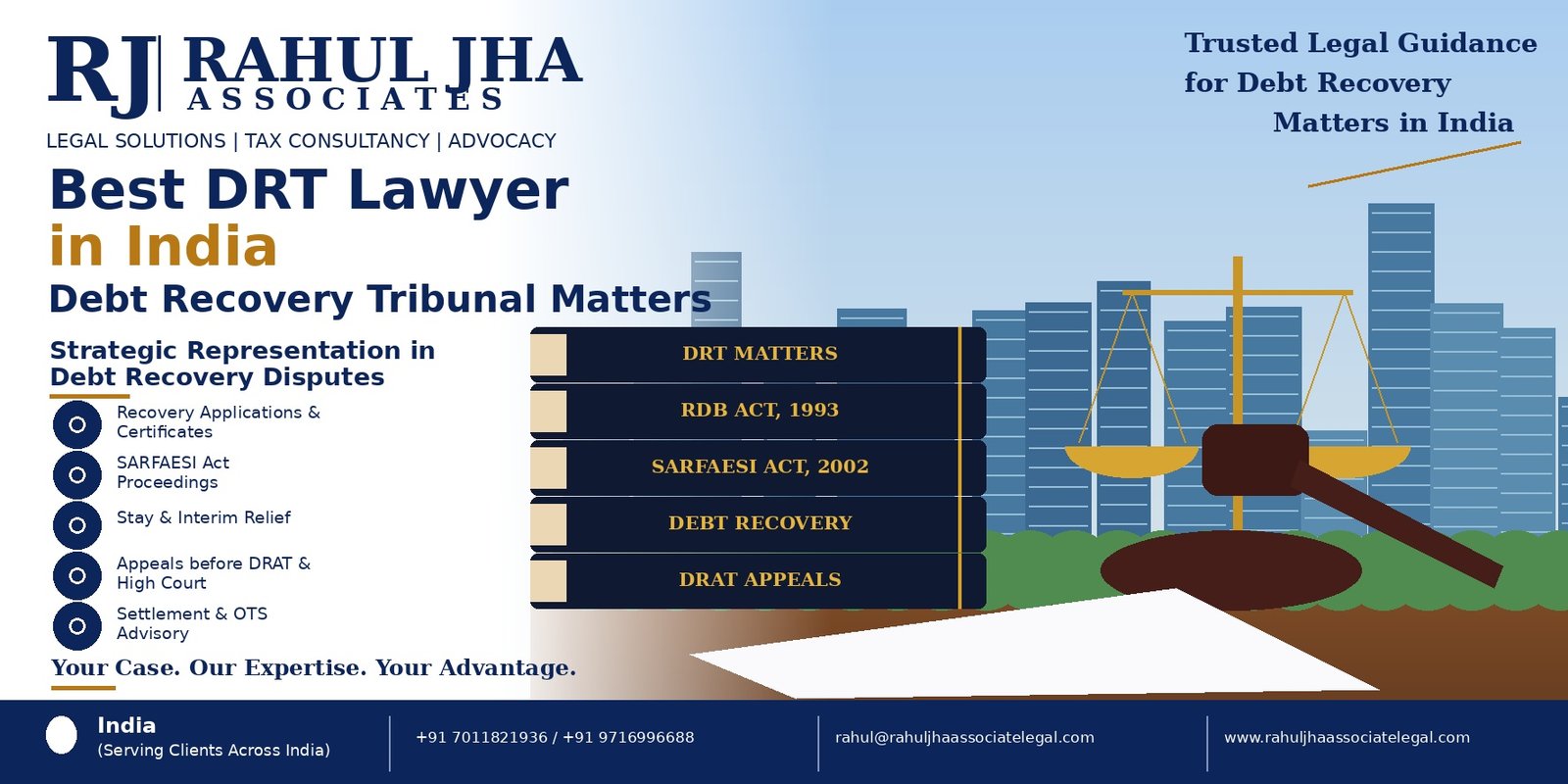
- Lodge Original Applications with DRT
- Handle SARFAESI procedures
- Filing Securitisation Applications
- Leading Recovery Claims
- Managing Loan and Mortgage Disputes
- Dealing with Guarantor Liability Issues
- Celebrating Bank Auction Disputes
- Managing Matters Relating to Possession
- Dealing with One-time Settlement Problems
- Interim Application Filing
- Appeals from DRTs to DRATS
- Representation in the High courts of the country with respect to related matters
On the face of it, the DRT’s website states that the RDB Act envisages Original Applications and Appeals proceedings before DRATE and DRD respectively.
DRT Lawyers, India’s Best Legal Services for Debt Issues
Rahul Jha Associates is engaged in providing assistance in litigation related matters of different types like corporate, commercial, civil, tax, FEMA, economic-offence, legal matters. The firm is engaged in legal practice, with a special emphasis on litigation services and money-recovery litigation being highlighted as key areas on its website.
1. Debt Recovery Proceedings
Sometimes, banks and financial institutions might start proceedings to recover their overdue debts. Legal counsel can guide the clients on the claims, analyze the basis from the loan records provided and help prepare proper legal pleadings and supporting documentation.
2. SARFAESI Matters
The Securitisation and Reconstruction of Financial Assets and Enforcement of Security Interest Act, 2002 is considered one of the key legislations under the Indian debt-recovery framework. According to the Government of India, this act is the legal instrument regulating securitisation, reconstruction of financial assets, and enforcement of security interests.
Borrowers or any other involved parties can seek legal assistance if they are subjected to takeover of assets, auction, or any other type of enforcement measure.
3. Bank Auction and Possession Disputes
Loans are often secured and a default could result in property being taken over for debt enforcement. The law firm can review what notices were sent by the creditor (secured party), go through the loan and security documents (copies), and verify the correctness of what steps have been so far taken under secured credit law.
4. Guarantor and Co-Borrower Matters
Guarantors and even co-borrowers sometimes find themselves caught in recovery proceedings. The attorney can assist with clarifying the type, extent and limitations of these obligations using agreements and the law that are relevant to such matters.
5. DRAT Appeals
DRT decisions or orders (Debts Recovery Tribunal) can also be appealed before the competent Debts Recovery Appellate Tribunal (DRAT). As per records on the official Government portal, DRATs have the jurisdiction to entertain appeals filed arising from DRT hearings only.
Advantages of Choosing Rahul Jha Associates:
Rahul Jha Associates has characterized its firm as a one-stop legal office which provides a variety of legal services relating to different fields i.e., corporate, commercial, civil, criminal, tax, FEMA, and economic matters. The firm also emphasizes on client-centred services such as preparing and providing documentation, reviewing and managing the file and also payment terms that are made clearly to the client, all through the website of the firm.
A lawyer’s broader experience with litigations might very well serve them well in the DRT context since a dispute related to the debt might still touch upon contractual, corporate, property or commercial and financial matters.
Deciding on the Right DRT Lawyer in India
To begin with, make a check on these points:
Specialised knowledge: A lawyer familiar with debt recovery disputes and financial issues.
Checking the documents: The loan agreement, the sanction letter, account statement, the mortgage deed, guarantee instrument, a notice, and the correspondence are some key documents.
SARFAESI familiarity: It is very vital to get familiar with SARFAESI if a bank or a financial institution is initiating the recovery procedures.
Appellate competence :A borrower might need to go for review of DRT orders in DRAT or possibly even seek legal remedies at higher courts which is quite common in the DRT system.
Quick response: Timelines and statutory procedure are vital for DRT and SARFAESI related matters. If you consult a lawyer after the legal issue has passed the timeline you could face some extra issues.
FAQs
1. Role and responsibilities of DRT lawyer
The DRT lawyer represents and gives legal assistance to the parties such as borrowers, guarantors, banks, financial institutions, etc., who come up to debt recovery, SARFAESI measures, securitisation applications, and appeals there-of.
2. Is a borrower allowed to challenge recovery action by the bank?
In the light of the situation and the law, the borrower or the party affected by the recovery action may very well have the right to challenge the recovery action before the designated tribunal or the court.
3. Can DRT lawyer help in case of a property being auctioned by the bank?
Aye. The lawyer will examine the notice, the loan, and security documents, the enforcement procedure and then explain the client as to his legal options.
4. Difference between DRT and DRAT
In the first instance, the DRT handles eligible claims under the Debt Recovery Act and some recovery actions through the SARFAESI regulations whereas the DRAT is an appellate body in respect of specific orders made by a DRT.
5. Rahul Jha Associates How to help in DRT-related matters?
Rahul Jha Associates is experienced in handling legal issues related to commercial, civil, legal, financial sectors including debt recovery cases, and related litigious and financial disputes, and litigation services.
Conclusion
DRT and SARFAESI proceedings have a strong impact directly on borrowers’ financials, business operations and secured property, and therefore timely legal evaluation can assist clients in appreciating and getting ready for the claim, going over the evidence presented by the claimant and deciding upon an optimal legal action.
Should you be on the lookout for the top-notch DRT lawyer in India, Rahul Jha Associates provides both legal aid and dispute resolution assistance for debt recovery, commercial/ business, finance related and similar types of cases.