

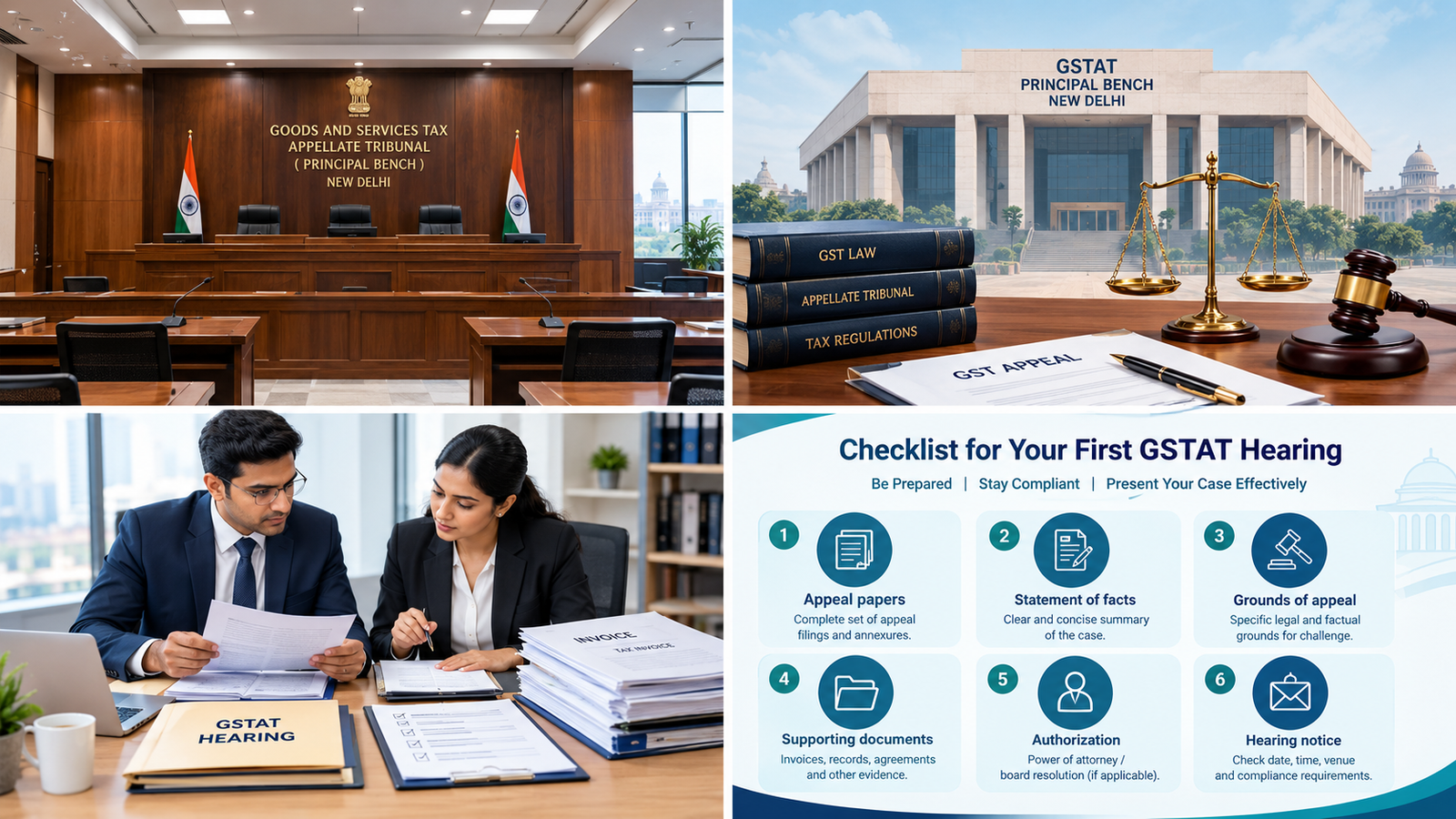
Attending a trial at the GSTAT Principal Bench in Delhi for the first time may feel unusual to a company when the conflict relates to a large amount of GST demand, input tax credit, classification, interest, penalty, refund, or any other complicated taxation problem. Adequate preparation is essential since the Tribunal takes into consideration the appeal record, submissions, relevant GST law, and the arguments made by the parties.
The GST Appellate Tribunal (GSTAT) was set up to provide second appellate authority for the GST disputes that are orders of the Appellate or Revisional Authorities under the relevant GST provisions.
Principal Bench is housed in New Delhi.
FAQs: GSTAT Principal Bench Delhi
Q1. What is the GSTAT Principal Bench in Delhi?
The Goods and Services Tax Appellate Tribunal at New Delhi, GSTAT Principal Bench is one of its main tribunals. It is responsible for dealing with GST appeals within its jurisdiction and works under the CGST Act, GSTAT Procedure Rules, and applicable directions.
Q2. What is covered in the first hearing of GSTAT?
Depending on the case, the initial session may comprise the identification of main issue or problem, preliminary submissions, review of appeal file, defining issues, legal arguments from both sides, and/or instructions for more documentation. The actual method is subject to the type of case and judge’s direction.
Q3. Is it possible for a company to participate in a GSTAT hearing from their office through video conferencing?
GSTAT portal supports hybrid hearings. With GSTAT Member’s consent, a hearing can be held electronically by a videoconference.
Q4. What is the way the business is informed that its case is on the panel?
GSTAT portal provides facilities of cause-list and case-status. Registered parties will be sent e-mails/SMS automatically once the listing information updates after they cause-lists get finalized.
Q5. Is it necessary for the business to have a GST lawyer for the initial appearance in GSTAT?
Having a GST lawyer is highly recommended for the business. A lawyer will not only represent the business in court but will also provide assistance on the entire procedure from the submission of the application to the preparation of the case for filing. This makes the first GSTAT hearing a much smoother process. However, one thing to note here is that a GST lawyer should have the necessary expertise in this field of tax.
What Is the GSTAT Principal Bench in Delhi?
Established as the second appellate forum for disputes relating to GST, the Goods and Services Tax Appellate Tribunal (GSTAT) is the body. The Government of India has set up the Principal Bench at New Delhi through Section 109 of the CGST Act.
The current GSTAT website marks the Principal Bench as the Government of India tribunal and offers e-filing, cause lists, case status, orders/judgments, and display-board information
For a business the GST dispute goes a level higher when the taxpayer has a ground to challenge the order made by a lower authority that has passed it.
What Should a Business Do Before Its First GSTAT Hearing?
1. Read the Impugned Order Again
Your preparation should not start with the GST order only.
Determine the order that you are challenging before GSTAT
- Demand of tax
- Interest
- Penalty
- A fight over input tax credit
- Classification issue
- Valuation issue
- Refund issue
- Procedural objections
- Findings made by the lower authority
- Reasons given by the department for rejecting your appeal
At the end of it, it should be absolutely clear which decision you wanted changed and how. h22. Go through the entire appeal record
Your first GSTAT case shouldn’t feel like the discovery of the entire history at once.
Make a time-ordered file comprising of:
- Show-cause notice
- Departmental reply to notice.
- Adjudication order.
- Order of first appeal.
- Appeal before GSTAT.
- Factual statement.
- Reasons for the appeal,
- The bills that support a business’s argument
3. Know Your Reasons for an Appeal
A business should be in a position to put their story across in a straightforward manner.
Let us say the department said that transaction is taxable at X rate, while the taxpayer’s stand was that classification should be Y because the goods satisfy the relevant criteria.
4. Prepare the One-Page Case Notes
If you make a point of having a one-page summary in a fresh GSTAT hearing, it is likely to greatly facilitate the proceedings.
The page might include information like
- GSTIN
- Appellant
- Appeal Number
- Assessment
- Dispute Period
- Tax Disputed
- Penalty
- Interest
- Main Issue
- Main Grounds
- Relief Requested
This gives the representative a clear overview of the whole case just before the hearing commences.
5. Check the Cause List and the Status of Your Case
An email containing the old hearing date you received is not the final word.
There is a section on the GSTAT website, which has links to the cause list and to check the status of your case. In addition, the portal sends messages about case developments.
According to a frequently asked question on e-filing at GSTAT, parties who are registered will receive SMS/email notifications of the listing of your appeal after the finalization of the cause lists.
Accordingly, businesses may wish to verify, among other things,
- Appeal number
- Bench
- Date of hearing
- Case status
- Cause-list position
- Any notice or direction
6. Anticipate Questioning From the Bench
The first hearing is definitely not the place to just read out a summary of all that the appeal includes.
Judges may ask questions that you may not be able to answer just by reading out your appeal, like
- What exactly is your complaint?
- What sum of money is in contention?
- What proof do you have for making your claim?
- What was the decision of the lower authority on this matter?
7. Find Out Your Standing Regarding Any Pre-Deposit
Before starting proceedings, businesses should ensure that they have cleared all outstanding legal filings (statutory pre-deposit), etc., to proceed with the case.
Within the GST system, there are conditions relating to pre-deposit of appeals; the e-filing portal of GSTAT provides separate advice as regards pre-deposit and online payment of court fees.
Since the amounts one has to pay can be different from dispute to dispute and at a different level of adjudication, businesses should figure out what they need, according to the latest law of the land and GSTAT’s rules.
8. Be prepared for either a physical or virtual hearing.
According to the GSTAT’s e-filing portal, the member, the court judge, has the liberty to choose either mode of hearing (physical or video call).
If the member decides on the virtual mode of hearing, the business should confirm ahead of time that everything required for such a hearing is in place:
- Internet connection
- Required PDFs
- Appeal papers
Local Example: Delhi Trading Company
Imagine a Delhi trading company that receives a GST demand letter regarding input tax credit.
The business thinks the ITC was validly claimed and has the following:
- Tax invoices
- GSTR-2B statements
- Books of purchase
- Proof of bank payment
- Communications with suppliers and dealers
- GST returns
It will be the GSTAT representative’s duty to gather the records and pin down the precise finding on which the appeal is based.
By this method, rather than just handing out all the unsorted records, the representative will be able to highlight a structure that the Bench will find easy to understand
Issue → Facts → Evidence → Law involved → Where the original finding went wrong → Request for a remedy
This strategy should help the tribunal better understand the matter.
Local Example: Noida Manufacturer Appearing in Delhi
A Noida manufacturer has a GST dispute and its appeal has been heard at the GSTAT Principal Bench in Delhi.
The company’s team is probably conversant with the commercial aspects only and not with the procedures before a tribunal.
Suffice it to say, the company will need a full briefing session that should include:
- Finance and accounts
- Tax
- Representative
- Management
They will go over the facts and figures and arrive at a consensus to prevent their arguments from being contradictory on the day of the hearing.
GSTAT Hearing preparation Process
The following is a typical GSTAT hearing preparation method:
Step 1: Determine the contested order
Be very thorough while reading the order to determine its basis.
Step 2: Determine the disputed amount
Break the claim into the tax, penalty, and other parts.
Step 3: Prepare timeline
Mark the events starting with Notice issuing up till the Appeal being filed.
Step 4: Match evidence and facts
Supporting documentation where possible should accompany statements of fact.
Step 5: Prepare your arguments in law
Identify the law, the rules, notifications, and precedents that apply to your case.
Step 6: Prepare questions and answers
Be ready to answer the Bench’s inquiries if they question your arguments.
Step 7: Check online status
Verify the cause list, notifications and case status on the portal of the GSTAT website.
Step 8: Choose your hearing mode
A physical mode is preferred. But in case the company is unable to attend it can use a virtual mode.
Step 9: Attend the hearing
Shorten your written submissions and respond to queries with clear answers.
Step 10: Monitor the case in the future
Keep checking the case status at GSTAT, any order or subsequent directions.
Main matters about GSTAT’s current digital system
GSTAT almost entirely moved over to electronic records management (erem e-record management). The official website includes e-filing, case-status, cause-lists, orders/judgments and facility for alerts notifications etc.
Also, the GSTAT portal mentions that appeals as well as their related proceedings are entirely online and the FAQ mentions that apart from offline submission in routine cases, no physical submission is required. There is also a e-Seva Kendra available for the assistance of online filing.
It follows from this that the companies need to have a well-arranged digital records file, not only paper folders.
Their Preparation Mistakes Before The First Hearing
If preparing the case, it is worth avoiding these common errors:
- Delay reading of an order up till yesterday before the day of the hearing
- The parties should know the disputed sum amount
- One should not bring along the documents and not prepare for indexing them
- Do not present assertions of the facts without the supporting documents/records
- Do not overlook, read the appellate order in detail, understand its grounds
- Do, if possible, get an accountant as a guide, but make sure also to understand the dispute yourself
- Do not, without the possibility to obtain a final order, be present at a hearing
- Do not miss notifications from the portal
- Do not, for example, refer to outdated GSTAT procedure information
- Do not see a technical or legal problem as just an accounting issue
Reasons Why You Should Employ a GSTAT Adviser/Lawyer
A single GSTAT case at issue may involve, among other areas, GST law, procedure, Evidence, the interpretation of the GST provisions.
It might help to get a GST lawyer or someone else who has knowledge of or experience with the working of the GSTAT system if you are at a loss in relation for example, to:
- Understanding your case
- Drafting an appeal
- Statement of facts
- Grounds of Appeal
Matters to Check at Delhi GSTAT before first hearing
It is advisable before one’s first appearance before the Principal Bench to do the following verification checks:
☑ Appeal number correctly entered
☑ Cause list consulted
☑ Hearing date, Bench confirmed
☑ Impugned order obtainable
☑ Grounds of appeal clearly known
☑ Disputed tax amount adjusted to
☑ Relevant documents indexed