

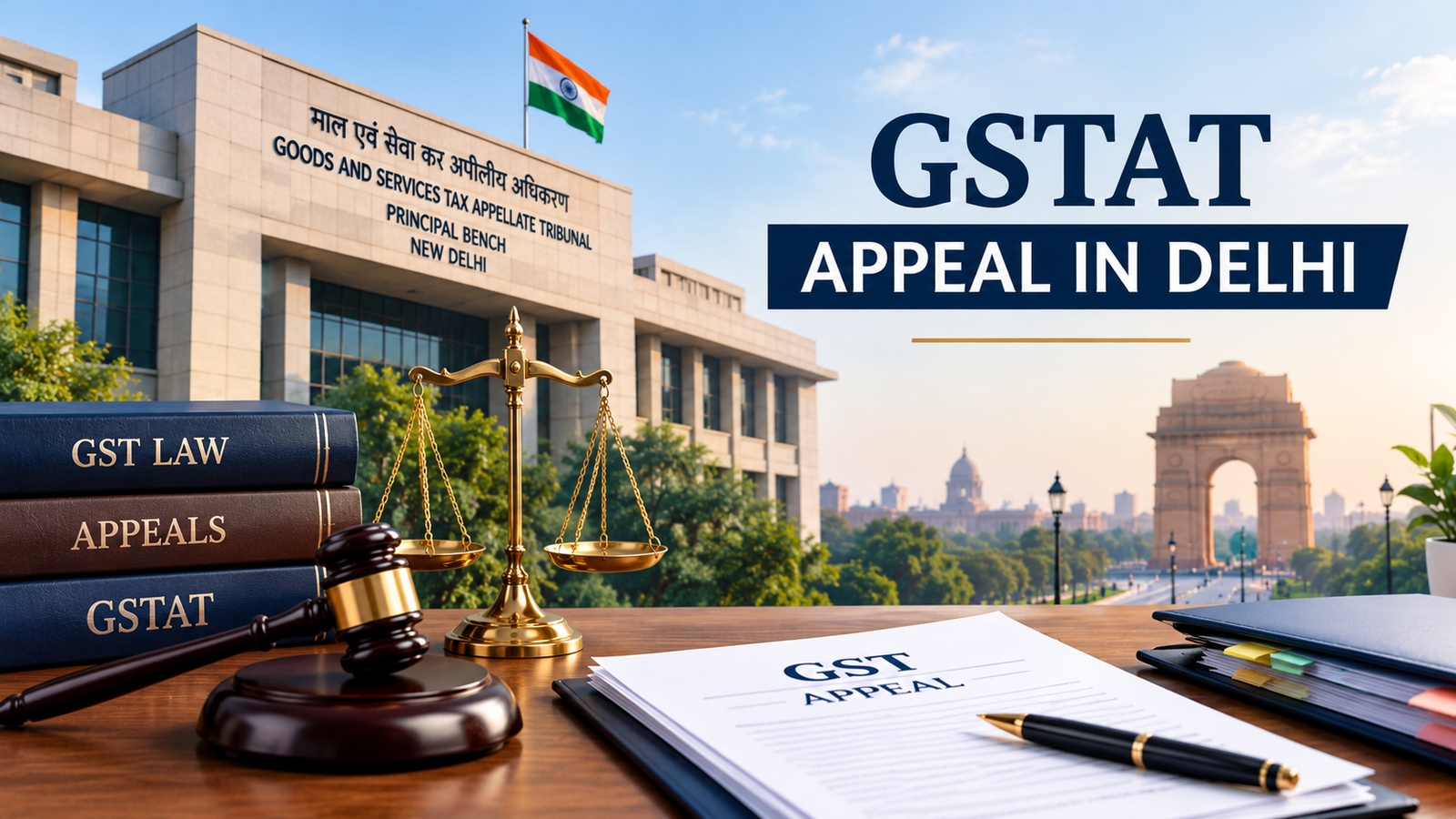
The taxpayer is normally required to approach the Goods and Services Tax Appellate Tribunal (GSTAT) under Section 112 of the CGST Act if dissatisfied with the appealable orders of the GST Appellate Authority or GST Revisional Authority, such as keeping into account the limitation period, pre-deposit, filing of documents & nature of the dispute.
Taxpayer application limitation eal form things, FORM form things, and FORM GST APL-05-05 is the prescribed form for a taxpayer appeal and is e-filed through the GSTAT system. It requires the taxpayer to prepare athe taxpayer to prepare a statement of facts andfacts and grounds for the appeal, upload the appellatethe appellate order and other documents, pay the fees,fees, and complete the pre-deposit.
A GSTAT lawyer in Delhi can undertake the legal review, drafting of appeal,appeal, calculation of pre-deposit, APL 05 filing, filing of deficiencies, written arguments,arguments, and tribunaltribunal representation.
The GSTAT portal provides online filing, case monitoring & related services to the taxpayers & duly authorized representatives.
FAQs About GSTAT Appeal in Delhi
1. Which form is used to file an appeal before GSTAT?
The taxpayer generally files an appeal before the Appellate Tribunal in FORM GST APL 05 (online submission). The official GSTAT portal also refers to APL-05 as the appeal form for taxpayers.
2. Can I appeal an order passed by the GST Appellate Authority?
Section 112 provides for the right of a taxpayer to approach the Appellate Tribunal against certain orders made by the Appellate Authority or Revisional Authority under statutory conditions.
3. Is pre-deposit mandatory for GSTAT?
Yes. A taxpayer must make a statutory pre-deposit, which is the requirement for the taxpayer’s GSTAT appeal to be valid. Also, a taxpayer must calculate the amount of statutory pre-deposit under the relevant law applicable to such an appeal and that date, and the reason is that statutory pre-deposit provisions have been amended and the GSTAT portal FAQ may not necessarily reflect every such amendment in the same words from the law.
4. What is Form APL-05?
Form APL-05 is the form used for appeal to the Appellate Tribunal and is a mandatory form. It includes such information as the name of the appellant, the impugned order, the disputed amount, the statement of facts, the grounds of appeal, and the prayer. the prayer.
5. Can a GSTAT lawyer assist with the entire appeal?
Lawyers and other legally authorized representatives may help in various aspects of an appeal,appeal, such as case analysis, drafting, filing, documentation, written submission, and oral representation, and also depending on eligibility requirements for legally authorized representatives.
6. What happens in case GSTAT identifies some problems in the appeal?
GSTAT filing is dependent on the registry’s scrutiny. Where flaws are pointed out, they havethey have to be resolved under the relevant GSTAT procedure for the matter to be taken further.
7. Is GSTAT filing in Delhi via online?
Delhi’s GSTAT filing is done online.
GSTAT has an electronic filing system for appeals and related proceedings; the official GSTAT portal also has case-management and tracking facilities.
What Is GSTAT?
The Goods and Services Tax Appellate Tribunal (GSTAT) is the second appellate forum in the GST dispute-resolution system.
We’ll explain in simple terms the litigious. GST route:
Adjudicating authority → GST Appellate Authority → GSTAT → High Court, where statutory appeal is possible
Hence, an adverse order from the first Appellate Authority doesn’t automatically exhaust all possible statutory avenues for appeals by taxpayer.
But, first thing, the taxpayer should be aware that he should check for a possibility of an appeal before the GSTAT for that particular order as well, and that he should not miss statutory limitation or other condition, if any, for such an appeal.
When Can You Appeal a GSTAT Order in Delhi?
You may be required to appeal if a GST appellate authority gives you a wrong decision relating to matters such as:
- GST Demand
- Reversal of Input Tax Credit
- Miscellaneous Charges and Interest
- Liquidity Charge and Penalty
- Tax Classification
- Tax Rate Determination
- Product/Service Valuation
- Bond and Duty Refund Matters
- Registration-related Disputes
- Credit for transitional period
- Place of Supply-related questions
- Appealable matters under GST Law
It is only by looking at the content of the order that you may know what remedy is available. So, say a business house situated in the Okhlathe Okhla Industrial Area, Delhi, had filed a petition at the level of the first Appellate Authority against the demand for ITC. The authority then decided in favor of the department, and the taxpayer can see if Section 112 of the GST Act provides a stage for appeal further to the GSTAT.
Step 1: Your GSTAT Lawyer Reviews the Appellate Order
The lawyer will be able to pinpoint the areas where you stand to lose in the appeal by carefully reading the appellate order and other relevant records. A GSTAT lawyer should analyze all of the following:
- Show-cause notice
- Primary adjudication order
- Response made to the show-cause notice
- Documents submitted as evidence before the GST department
- First appeal
Step 2: Preparation of the Appellate Grounds
Appellate grounds or statements of objections form the main section of APL-05. Grounds for the appeal could be anything from
Misapplication of Law: Legal provision being misconstrued
The taxpayer in this case might submit that the law as it stands has been interpreted incorrectly or wrongly applied by the officer.
Incorrect facts recorded
Sometimes, in the appellate orders, the facts and evidence mentioned or decided upon do not agree with that of the documentary evidence or witness statement.
Disregarding evidence by the appellate authority
If a taxpayer is able to show that a relevant document or submission was not properly considered and/or admitted by the tribunal or that the evidence was not taken correctly by the department, then he may file a complaint challenging the order.
Miscalculating theMiscalculating the demanded taxtax
The amount of tax, ITC reversal, interest, or penalty that is in dispute may require to be reassessed or recalculated.
Procedural Grounds
According to the circumstances, some points arising out of an opportunity to be limited, records heard, or compliance with the principles of natural justice may become part of the case.
Step 3: Accurately Figure out the GSTAT Pre-Deposit Amount
Pre-deposit forms are one of the most important aspects of a GSTAT appeal. This area requires particular care because GSTAT’s Frequently Asked Question page indicates that the taxpayer appeal requires a first-appeal pre-deposit and GST Revisional Authority, such as keeping also a 20% pre-deposit of the contesting tax amount.
On the other hand, the new 2026 legal directions regarding the updated laws have revealed that the Tribunal stage demand is to only give 10% of the remaining contested tax amount, the one on the record already having been deposited at the first appeal stage, and a maximum is to be set.
As such, one cannot just take the 20% from an old document or even be content with a general calculator. A taxpayer should, prior to making a payment, confirm the relevant statutory provision, the effective date, the kind of request and, most importantly, the latest GSTAT filing instructions.
Step 4: Complete the GST APL-05 Form
Submission of the taxpayer’s GSTAT appeal occurs through the GST APL-05 form.
This officially authorized form gets information such as:
- GSTIN/other unique identifier
- Appellant’s name and address
- The order being contested
- The entity that issued this order
- Communication date
- Attorney’s/representative’s description
- Dispute summary
- Disputed amount
Step 5: Attach Supportive Evidence
In conjunction with the appeal, you are supposed to present documentary evidence well-ordered as a matter of principle.
Such documentation may consist, among other things, of:
- Notice issued because of the show-cause
- Decision by the adjudicating authority
- Appellate order
- GST returns
- GSTR-1 (supply to recipients)
- GSTR-3B returns summary statement (input tax credit)
- GSTR-2B (inward supplies by supplier based on inward invoice)
- the limitation limitation Tax invoicesTax invoices
- Purchase records The taxpayer records the taxpayer records A limitation: GSTATPurchase records
- Sales registry Sales registry
- Transport documents
- Covenants
- Bank recordsBank records
Step 6: GSTAT Filing Fee Payment
Step 7: Submission of APL-05 via GSTAT Portal
In general, appeals are filed through the portal system.
On the official website of GSTAT, it is stated that taxpayers can do the following:following:
- Registration & logging in; and
- Filing of appeals; and
- Uploading of documents; and
- Making of payments, insofar asinsofar as the law allows it; and
- Catching up on the progress of your case; and
- Get notifications from the system; and
- Monitoring case status.
You can expect the portal to generate a provisional acknowledgment as soon as the submission gets through, and it will send the final acknowledgement when scrutiny and registration are completed, provided the conditions for filing have been met.er.
Step 8: Registry of GSTAT Reviews the Appearance of Appellant
Filing the APL-05 is only a small part that needs doing here
During the time the registry may spot some of the errors related to :
- Unavailability or loss
- Provide incorrect or misleading information
- Payment related problems
- Mistake in the style or form
- Verification process (if needed)
- Deficient supporting documents
- Procedural other requirements
It is possible that the taxpayer will be required by the law to correct these mistakes under some specified way.
The lawyer can continuously keep an eye on the portal and quickly respond to the registered grievances thereby avoiding any further delay in hearing the case.
Step 9: GSTAT Lawyer Drafts Written Applications
In a typical case before the Tribunal, the submission of APL-05 only represents, in essence, the very limited amount of the materials which must be put forward by the taxpayer.
Usually, the lawyer will compile an extensive written submission covering, inter alia, the following topics:
- Summary of incidents
- Facts in dispute
- Description of issues in the contested order
- The errors committed in the aforementioned issues
- Evidence to be presented (document-based)
- Judicial case law related to the issue
- Comments on the arguments put forth by the department
- What the petitioner is asking for (relief requested)
What is it That a GSTAT Lawyer in Delhi Actually Does?
The services of a lawyer will be valuable at different steps.
Legal advice and analysis
An order will have to be gone over so that any grounds upon which one might make an appeal may emerge.
Limitation aspect
Based upon what the law says about how long you have to do something after receiving information of the decision, limitation lawyer can advise you how much time you have to prepare and submit appeals.
Determination of pre-deposit
Under the relevant provisions of the law, this determines the pre-deposit amount.
APL-05 draft
A statement of facts, reasons, and prayer (APL-05) is the document the attorney is responsible for preparing.
Document preparation
Docketing the records of the appeal and arranging related evidence.
Electronic filing
Assisting with online submission and filing.
Carefully handling defects
The lawyer’s help is essential in getting past registry objections and refiling papers where necessary.
Step 3: Accurately Figure out the GSTAT Pre-Deposit Amount
Pre-deposit forms are one of the most important aspects of a GSTAT appeal. This area requires particular care because GSTAT’s Frequently Asked Question page indicates that the taxpayer appeal requires a first-appeal pre-deposit and also 0% pre-deposit of the testing tax amount.
On the other hand, the new 2026 legal directions regarding the updated laws have revealed that the Tribunal stage demand is to only give 10% of the remaining contested tax amount, the one on the record already having been deposited at the first appeal stage and a maximum is to be set.
As such, one cannot just take the 20% from an old document or even be content with a general calculator. A taxpayer should, prior to making a payment, confirm the relevant statutory provision, the effective date, the kind of request and, most importantly, the latest GSTAT filing instructions.
Step 4: Complete GST GSTAT’form.sAPL by an invoice-05 Form
Submission of the taxpayer’s GSTAT appeal occurs through the also aAPL byGS APL-05 form.
This officially authorized form gets information such bank things,stage,such as as
- GSTIN/other unique identifier
- Appellant’s name and address
- The order being contested
- The entity that issued this order
- Communication date
- Attorney’s/representative’s description
- Dispute summary
- Disputed amount
Step 5: Attach Supportive Evidence
In conjunction with the appeal, you are supposed to present documentary evidence well-ordered as a matter of principle.
Suc of invoice orders, grievances, GST is an invoice order. grievances, GST is an invoice order. consist of invoice orders. consist, among other reinbank things, of the regG of invoice orders. STinbank things, of the regGST, regGST invoice order. istry bank things, of:
- No bank things, no notice issued for payment-related because of the records here. as an invoice show cause records show cause
- Decision by the adjudicating authority
- Appellate order
- GST returns
- GSTR-1 (supply to recipients)
- GSTR-3B returns summary statement (input tax credit)
- GSTR-2B (inward supplies by supplier based on inward invoice)
- to: may be to: may be that form it? order. Lawyerbank things, such as hermet. e.g., an invoice order. Tax invoices
- arePurchase recordsarePurchase records
- Bank recordsSales registryBank recordsSales registry
- Transport documents
- Covenants
- Bankrecords
Final Takeaway
A GSTAT appeal in Delhi is far more complicated than just filling out Form APL-05.
The steps involved areareare
Go through the appellate order.order. → Make sure of the limit of time available → Figure out the grounds → Pre-deposit calculation → Completing the APL-05 form → Gathering supporting documents → Payment of the fee → Submitting the application through e-filing → Correcting the registry defects → Writing down the contentions in the reply/petition → Appearing in the GSTAT hearing → Getting the final order from the department.